Training Software That Speaks Your Methodology
Balanced and Science-Based programs don't just use different tools — they use different words for the same moment in a session. Pet Ops changes the fields on screen to match, instead of asking every trainer to translate.
Why Vocabulary Decides the Trial
A trainer evaluating Pet Ops once asked, early in a demo, whether our board-and-train and behavior tracking matched her science-based protocols. At the time, the honest answer was no. The fields on screen used a different vocabulary than the one her intake conversation used, and that mismatch was enough to end the trial before it started. Nothing about the underlying software was wrong for her — the words in front of her were.
Every program agrees on a foundation: criteria, a marker, a cue, the 3 Ds of distance, duration, and distraction, and fluency as the goal of a well-run rep. Past that shared foundation, the vocabulary splits hard, and the split is not cosmetic — it signals which camp wrote the software. Methodology support is a sales-qualification feature, not a nice-to-detail-later. It decides whether a trainer keeps evaluating or closes the tab.
What Ships
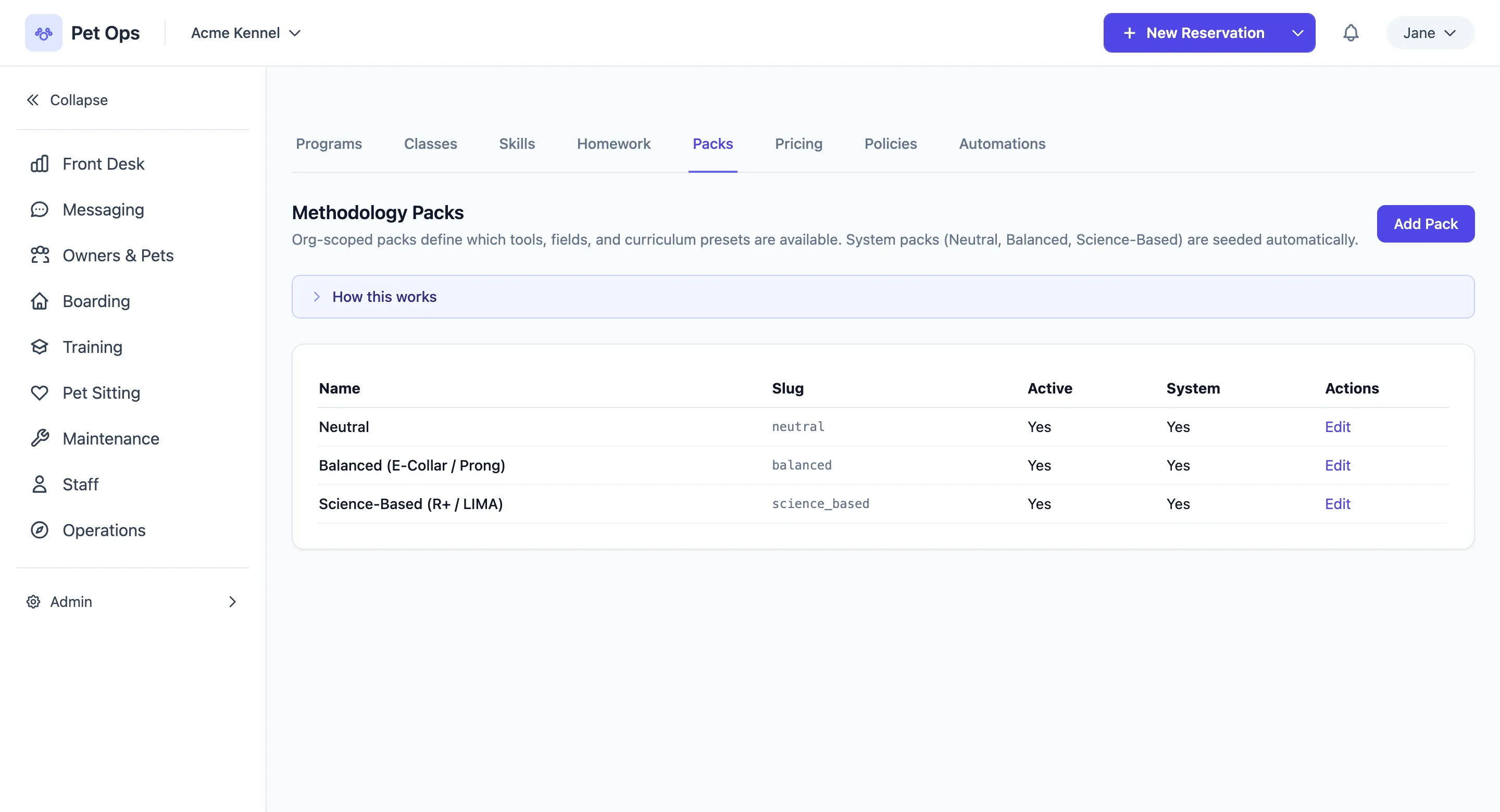
Pet Ops ships three seeded methodology packs: Neutral, Balanced, and Science-Based. Switching a dog's pack does not just relabel a dropdown — it changes which fields exist on that dog's training record, because a Balanced session and a Science-Based session document genuinely different things.
Neutral is the default: the 3 Ds, skill stages, and homework, with none of the camp-specific fields below. It is the right starting point for a program that hasn't standardized on a single methodology, or that mixes clients across both.
What a Balanced Trainer Sees
Switch a dog to the Balanced pack and the record reshapes around how balanced programs actually document a session: working level per dog per context, a distance ladder for proofing a behavior further from the trainer and further into distraction, and tool tracking that logs prong, e-collar, and leash-pop use alongside pressure on/off timing. A correction is logged against the criteria that triggered it, not dropped into a free-text note where it loses that context.
Programs follow the same logic. Build the program once, adopt one from the Pet Ops library, or duplicate one you already run. A board-and-train stay can walk from place-command foundations through off-leash proofing, in the order a balanced program actually teaches it.
What a Science-Based Trainer Sees
Switch to Science-Based and the record reshapes again: ABC (antecedent-behavior- consequence) logs for capturing reactivity between sessions, threshold tracking and reinforcement rate, desensitization/counter-conditioning (DS/CC) protocol parameters with antecedent arrangement as its own field, a written management plan, and LIMA escalation documentation for cases that need to justify moving up the hierarchy.
Aversive-tool fields — prong, e-collar, and leash-pop logging — are not just discouraged in this pack. They are hidden entirely. That isn't a policy line in a manual; it's the actual field set a Science-Based trainer sees on screen, and it's the clearest proof the neutrality on this page is real rather than marketing.
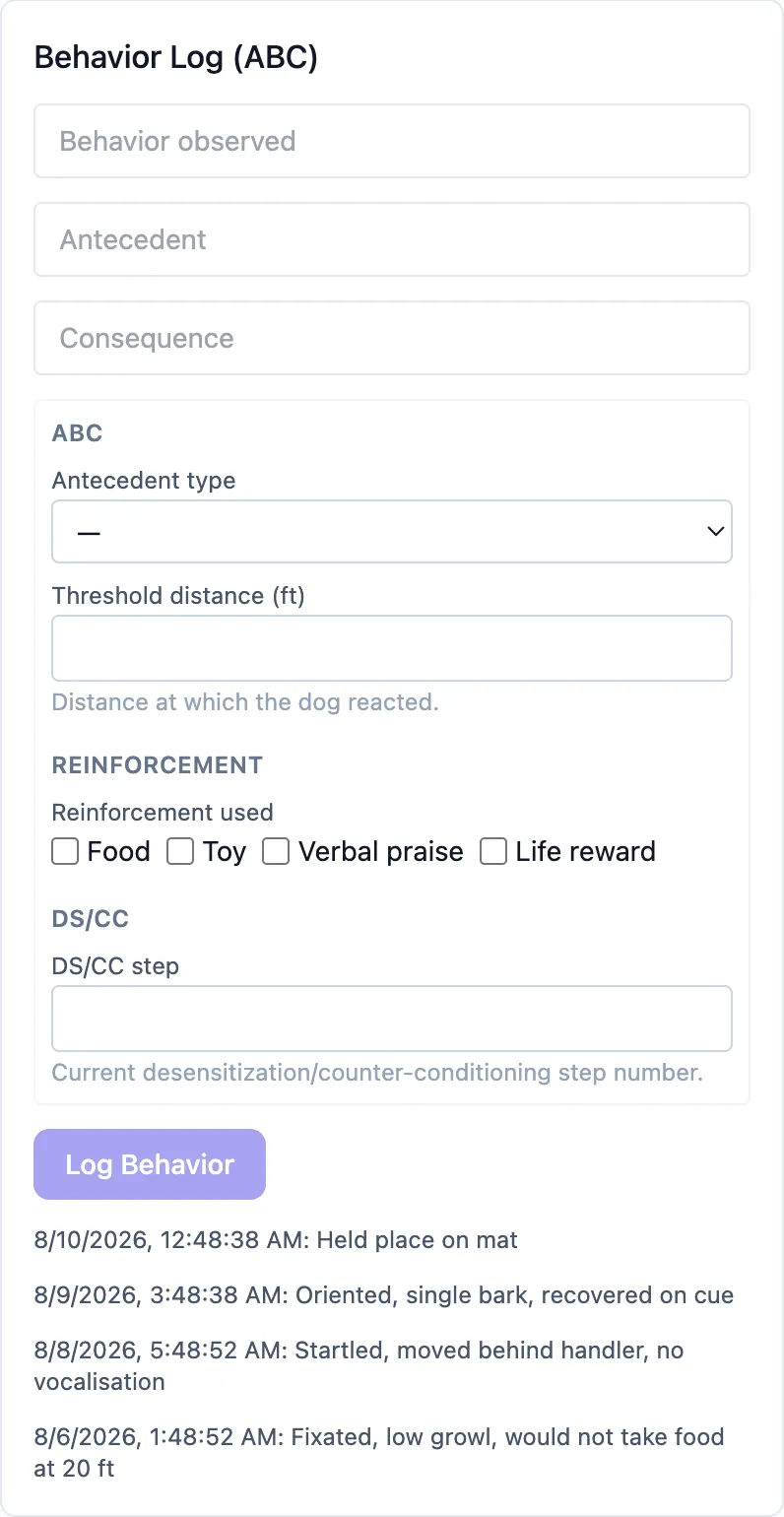
The Science-Based field set: threshold distance, reinforcement, DS/CC step — and no tool-logging fields anywhere on the form.
Behavior Work Is Not Graded
An obedience skill can carry a fluency level because a sit either holds or it doesn't. A reactivity case cannot be scored the same way. Behavior-modification skills in Pet Ops are tracked by stage and trend — improving, holding, regressing — never by a letter grade.
A dog working through leash reactivity does not get a "B+" on a report card. That framing is the lost-prospect problem from the top of this page, in miniature: reducing a behavior case to a grade tells a science-based trainer everything they need to know about whether the software understands the work, and the answer would be no.
Coming soon
A 30-second walkthrough of switching a dog between packs and watching the field set change. We'd rather ship this page without a screenshot than ship one that doesn't actually show a pack-fields editor.
Your Own Method
Neutral, Balanced, and Science-Based cover most programs, but they are not the ceiling. Every field, label, and pack is defined in the admin UI — no code, no API calls, no ticket to us. If your program runs a hybrid vocabulary, or a methodology of your own devising, you build it the same way we built the first three.
Related Reading
Stop Asking Trainers to Translate
See the fields your program would actually use — pick a pack and try it, or build your own in the admin UI.
Start Free