A Report Card for Every Delivery Model, Not a Status Text
Pet Ops turns training progress into something an owner can actually open and read — skill stages, session notes the trainer chose to share, and class attendance, delivered straight into their portal.
Most Training Updates Are Adjectives
"Great day, lots of progress!" is not evidence. It is the sentence an owner gets when the software behind the program has nowhere structured to put progress, so it collapses into a group text or a generic status update.
An owner paying for board-and-train, day training, private lessons, group class, or virtual coaching is buying a result they cannot watch happen. The report card is the proof that the result is real — and that it is specific to their dog, not a template.
Every skill sits in a stage, with a trend line from the sessions and homework logs behind it — not a one-word summary.
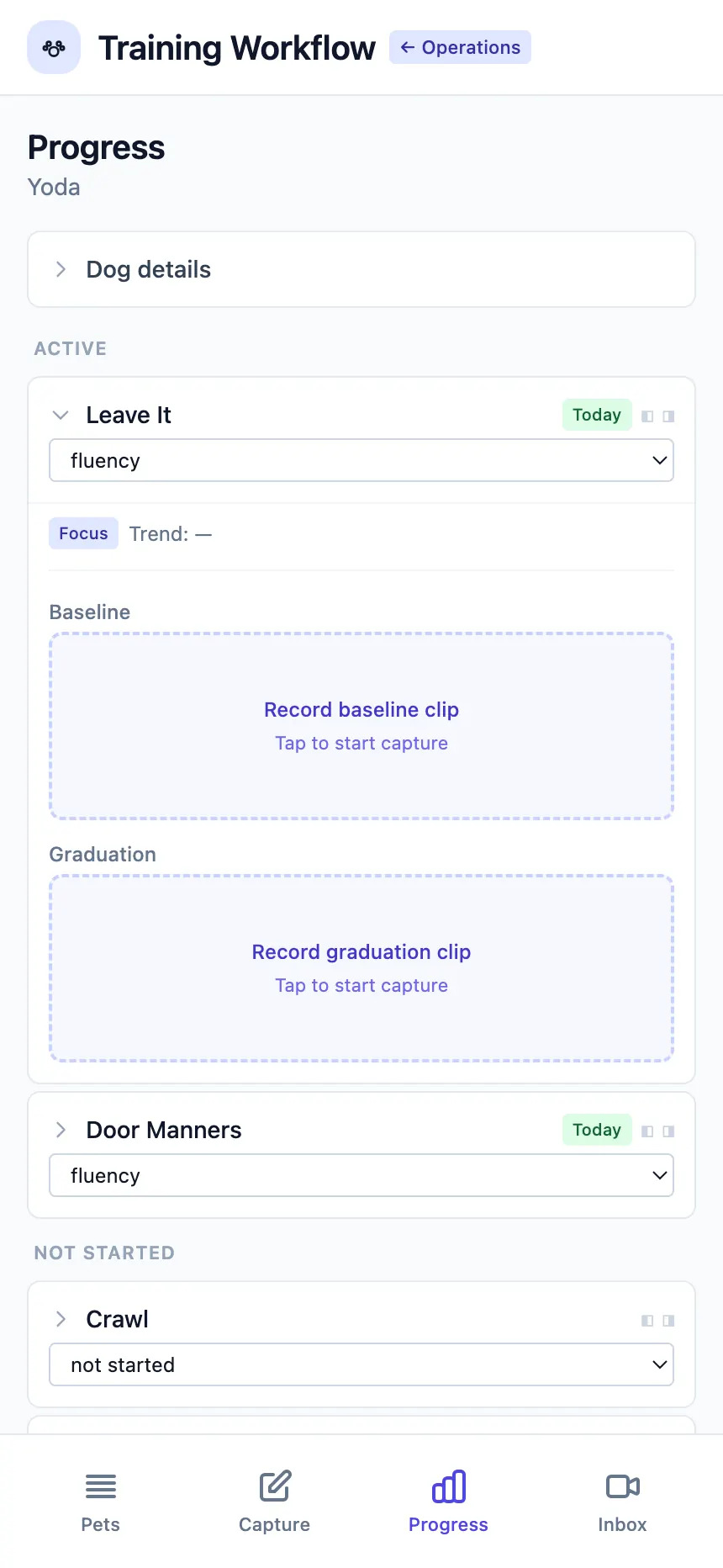
Skill Stages, Not Adjectives
Every skill a dog is working on sits in a stage — where it is in fluency and generalization, not a letter grade. Recent sessions and homework logs feed a success-rate trend for each skill, so an owner can see whether "sit-stay with distraction" is actually getting more reliable, not just hear that it is.
Behavior-modification work is never graded. A reactivity case does not get reduced to a B+ — it gets a stage and a trend, the same as every other skill on the record.
One Report Card Shape, Five Delivery Models
A report card is not one generic template stretched over every program. Each delivery model surfaces what actually matters to that owner:
- —Board & Train and Day Training: skill stages and trends across the full stay or the daily loop
- —Private Lesson: progress session-by-session, tied to what was covered that visit
- —Group Class: a roster-week attendance summary alongside the same skill stages
- —Virtual Coaching: a timeline of the owner's own practice logs and the trainer's feedback on each one
The Narrative Comes From What the Trainer Publishes
The skill-stage view itself carries no written narrative — no raw notes, no transcripts, no AI-drafted summaries. Those stay on the staff side of the platform, always. An owner gets narrative context only when a trainer publishes it: a session note in their own words, or a short highlight tagged as a Win or a What we're working on for a specific skill.
AI can draft a session summary to save the trainer typing, but a draft is not a publish. The trainer decides what goes on the record an owner sees — line by line, not with a blanket toggle.
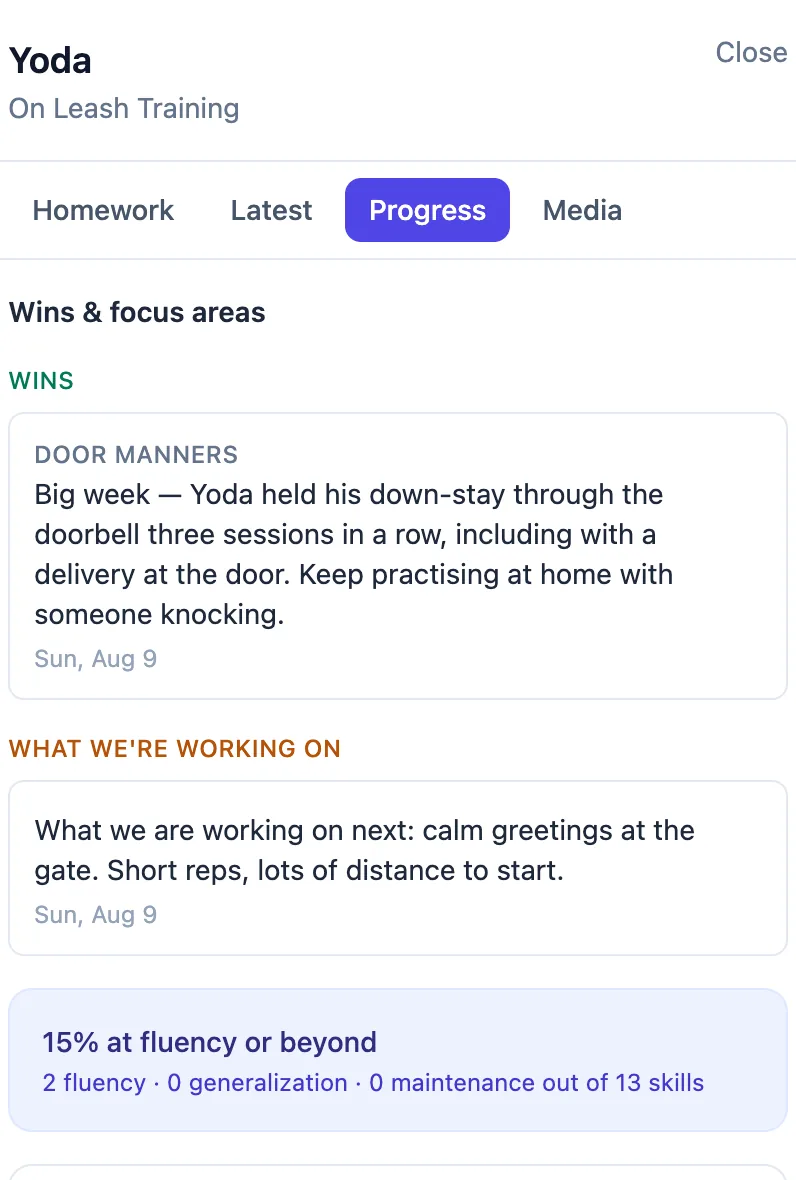
Both entries here were written and published by the trainer. The percentage is counted from skill stages, not from anything a model decided.
Attendance and Practice, Counted Honestly
Group class attendance is a summary of the sessions that were actually marked — present, absent, excused, or made up elsewhere. Sessions nobody got around to marking yet are not counted as attended or missed; they simply are not in the summary until someone marks them.
Virtual coaching enrollments get a practice timeline instead of a roster: every practice video the owner logged, with the trainer's feedback on each one and when the trainer reviewed it.
Who's Training Your Dog
Every report card ends with a short trainer byline — name, photo, and any credentials the trainer has added to their own profile. It is self-reported by the trainer, the same way a bio page would be, not a verified license lookup or a submission to a certifying body. It answers a simple question a report card should always answer: whose judgment is behind this progress.
Dog Training Video Software →
Where the clips on a report card come from
Dog Training Software →
The training core every delivery model shares
Delivered Where an Owner Already Looks
A report card is not a PDF to lose in a downloads folder, and it is not a public link that keeps working after the enrollment ends. A magic-link email drops the owner straight into their Pet Ops portal, signed in, looking at their dog's own record — nothing to print, save, or forward.
Related Reading
One Report Card Shape Does Not Fit Five Delivery Models →
Why board-and-train, classes, and virtual coaching each need their own report view
Skill Continuity Across Delivery Models →
What happens to a dog's skill record moving from class to private to board-and-train
Continuing Training After Checkout →
The owner loop that keeps a report card relevant after the program ends
Trainer Profiles and CEU Logs Belong in Ops →
Why credential data lives with the staff record, not the About page
Give Owners Something Worth Opening
Pet Ops turns every session, homework log, and class into a report card an owner can actually read — across all five delivery models.
Start Free